Professional headshot of a woman with short dark hair wearing a black blazer and beaded necklace against a dark background
Private Executive Advisory

Executive Identity

Where decisions are formed before they are made

Private 1:1 work with leaders under sustained pressure to stabilize the internal system from which their most critical decisions emerge.

The Executive Identity & Decision Architecture™ (EI&DA™)

A proprietary methodology for clarity, stability, and durable leadership authority.

Distilled from 35+ years in executive, government, and board-level environments — with direct observation of decision closure across 5,500+ senior decision-makers spanning industry, government cabinet, corporate boards, tech sector, and social impact governance.

SCROLL

Executive identity is becoming one of the most decisive leadership assets in modern organizations. As artificial intelligence reshapes decision-making, markets accelerate, and reputational cycles compress, leaders are increasingly evaluated not only by performance metrics — but by how they think, decide, communicate, and are perceived across complex environments.

In simple terms: executive identity is the system of decisions, behaviors, and authority signals that determine how powerful and trustworthy you appear as a leader — especially when the stakes are high.

At its core, executive identity connects a leader's internal operating model with their external institutional authority. It shapes how boards trust you, how organizations follow you, and how stakeholders interpret your judgment under pressure.

Unlike traditional executive branding — which focuses primarily on visibility, messaging, and positioning — executive identity operates at a deeper level. Branding expresses what is already there. Identity determines what that expression will mean.

What Is Executive Identity?

Executive identity refers to the consistent leadership pattern others experience over time.

It includes:

  • how a leader interprets ambiguity
  • how they structure high-stakes decisions
  • how they communicate direction
  • how they project authority in boardrooms
  • how they behave under stress
  • how their digital footprint reinforces credibility
  • how stakeholders describe them when they are not in the room

When these signals align, a leader is perceived as stable, strategic, and trustworthy.
When they fragment, authority erodes — even when operational performance remains strong.

For this reason, building executive identity is no longer optional career hygiene. It is a strategic discipline.

Executive Identity vs Executive Branding and Leadership Identity

Executive branding focuses on external perception: visibility, public narrative, thought leadership content, and market positioning.

Executive identity goes further. It asks:

  • From what decision logic do I operate?
  • What behavioral patterns repeat when stakes are high?
  • What does my leadership consistently signal to others?

Leadership identity usually describes how individuals see themselves as leaders. Executive identity expands this into the institutional arena — where boards, politics, power structures, regulators, and reputation interact.

In practice, executive identity is the bridge between leadership psychology and organizational authority.

Why Building Executive Identity Matters Now

Modern leaders operate in environments defined by:

  • AI-supported decision systems
  • heightened regulatory scrutiny
  • permanent digital visibility
  • volatile stakeholder expectations
  • compressed succession timelines

In such contexts, authority becomes pattern-based. Boards and organizations do not trust isolated successes — they trust leaders whose decisions, language, and presence form a repeatable system of reliability.

That system is executive identity.

Leaders with a coherent executive identity gain:

  • faster strategic mandate
  • stronger board confidence
  • reputational resilience in crises
  • clearer promotion trajectories
  • institutional influence beyond formal role

Core Elements of a Strong Executive Identity

01

Strategic Narrative

02

Decision Architecture

03

Authority Signals

04

Behavioral Consistency

05

Executive Presence

06

Digital Footprint

07

Stakeholder Perception

Together, these elements form the operational core of executive identity.

How to Build Your Executive Identity

1

Executive Identity Audit

Assess current patterns, gaps, and signals

2

Role Narrative Design

Craft the story that positions your leadership

3

Decision Pattern Mapping

Identify and refine your decision architecture

4

Stakeholder Alignment

Ensure perception matches intention

5

Digital Authority Strategy

Build credibility across digital channels

6

Symbolic Leadership Behaviors

Actions that reinforce identity consistently

7

Reinforcement Systems

Maintain and strengthen identity over time

Common Executive Identity Mistakes

  • over-reliance on messaging instead of decision systems
  • reactive crisis behavior
  • fragmented digital presence
  • unclear career narrative
  • authority derived from title rather than conduct

Executive Identity as Career Capital

Organizations increasingly treat leadership identity as:

  • a board-level risk factor
  • a succession-planning variable
  • a transformation accelerator
  • a reputational amplifier

For individual leaders, executive identity becomes portable career capital — something that compounds across roles, industries, and geographies.

It is strategic infrastructure.

The Distinction

Executive Identity Is Not Branding.
It Is Decision Infrastructure.

01

Decision Architecture

How you think under pressure

The internal structure that organizes how choices emerge — how information is filtered, risk interpreted, priorities set.

02

Authority Signals

How power reads you

The implicit cues that boards, stakeholders, and organizations use to assess your trustworthiness and strategic depth.

03

Strategic Narrative

How institutions remember you

The coherent story that positions your leadership across time, roles, and contexts — portable career capital.

Executive Identity is the foundation of leadership.

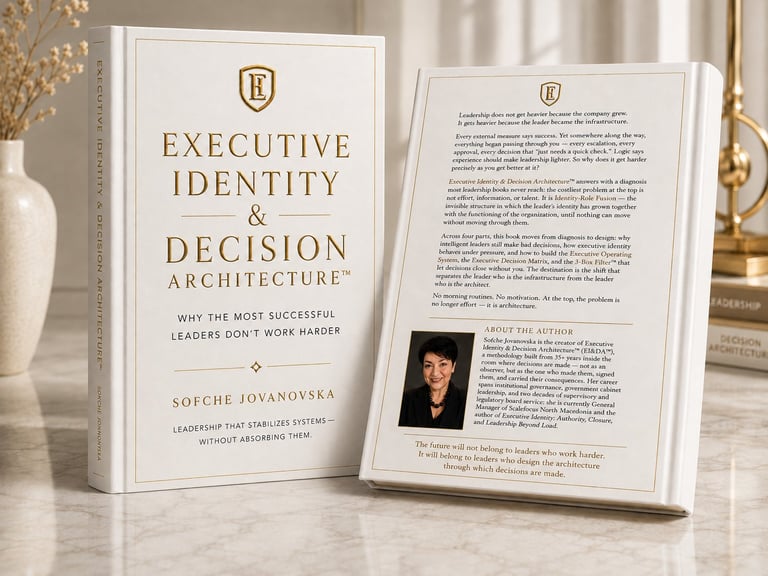
The EI&DA™ (Executive Identity & Decision Architecture) framework explains how executive identity shapes the architecture of strategic decisions within organizations.

Executive Identity & Decision Architecture book cover

The Book Behind the Methodology

Executive Identity & Decision Architecture™ (EI&DA™)

Authority, Closure, and Leadership Beyond Load

The Executive Identity & Decision Architecture™ framework did not start as a program.
It started as a question:

"Why do capable leaders eventually feel the weight of decisions as a personal burden?"

This book introduces a new language for a phenomenon many executives experience but rarely name — the accumulation of unresolved decisions.

Through six concise chapters it explores the concept of Decision Closure and the principle of Authority Without Load.

Explore the Book
The Process

Executive Identity Development

01

Audit

Current state analysis

02

Narrative

Role story design

03

Decisions

Pattern mapping

04

Alignment

Stakeholder sync

05

Digital

Authority strategy

06

Reinforcement

Sustained systems

Trust & Credibility

Why This Method Holds Under Load

EI&DA™ is not a theoretical framework. It is distilled from 35+ years inside executive, government, and board-level environments — with direct structural observation of decision closure, and its failure, across more than 5,500 senior decision-makers.

Industry

25 years at the Economic Chamber of North Macedonia. Direct working relation with decision-makers across 15,000 member firms. 4,000+ senior leaders in recurring, substantive contact.

Government

3 years as Chief of Cabinet to the Deputy Prime Minister for Economic Affairs. 150+ sessions of the Commission for Economic System. 1,500+ decisions prepared and closed. 700+ senior relations across government, cabinet, and international partners (EU, IMF, World Bank, EBRD).

Financial & Regulatory Boards

President of the Supervisory Board, Macedonian Development Bank. President of the Commission, Agency for Electronic Communications (Parliament-elected). Member of Supervisory Board, Clearing Inter-Banking System Skopje. President, European Economic Chamber (EEIG) for North Macedonia. Member of Executive Board, Employment Service Agency.

Sector & Social Impact

Executive Board, MASIT ICT Chamber of Commerce (two terms, current) — national technology sector governance. Executive Board, YES Foundation (2017–present) — youth entrepreneurship and innovation ecosystem stewardship.

Corporate Leadership

6 years as General Manager, Scalefocus North Macedonia. C-level and VP-level client relations across Europe and the United States. Regional executive leadership in a 1,000+ person technology organization.

Five governance dimensions. One consistent observation: the quality of the decision was rarely the problem.

The identity of the person expected to close it was.

That observation became a methodology.

Professional headshot of a woman with short dark hair, wearing a black blazer and black beaded necklace, smiling at camera

Executive Identity Architect

About the Founder

Sofche Jovanovska

Executive Identity Architect

Sofche Jovanovska has spent over three decades inside the systems where leadership carries permanent consequences — executive committees, regulatory environments, and complex institutional structures.

Her work addresses the internal architecture authority depends on: separating identity from role, stabilizing leaders under pressure, and restoring decision clarity without personal depletion.

Creator of Executive Identity & Decision Architecture™ — a discipline distilled from decades of senior-level exposure into calm authority, decisive closure, and sustainable command.

Your authority is already forming patterns.

The only question is whether they are strategic.

Request Executive Assessment

30-minute strategic conversation. No obligation.